
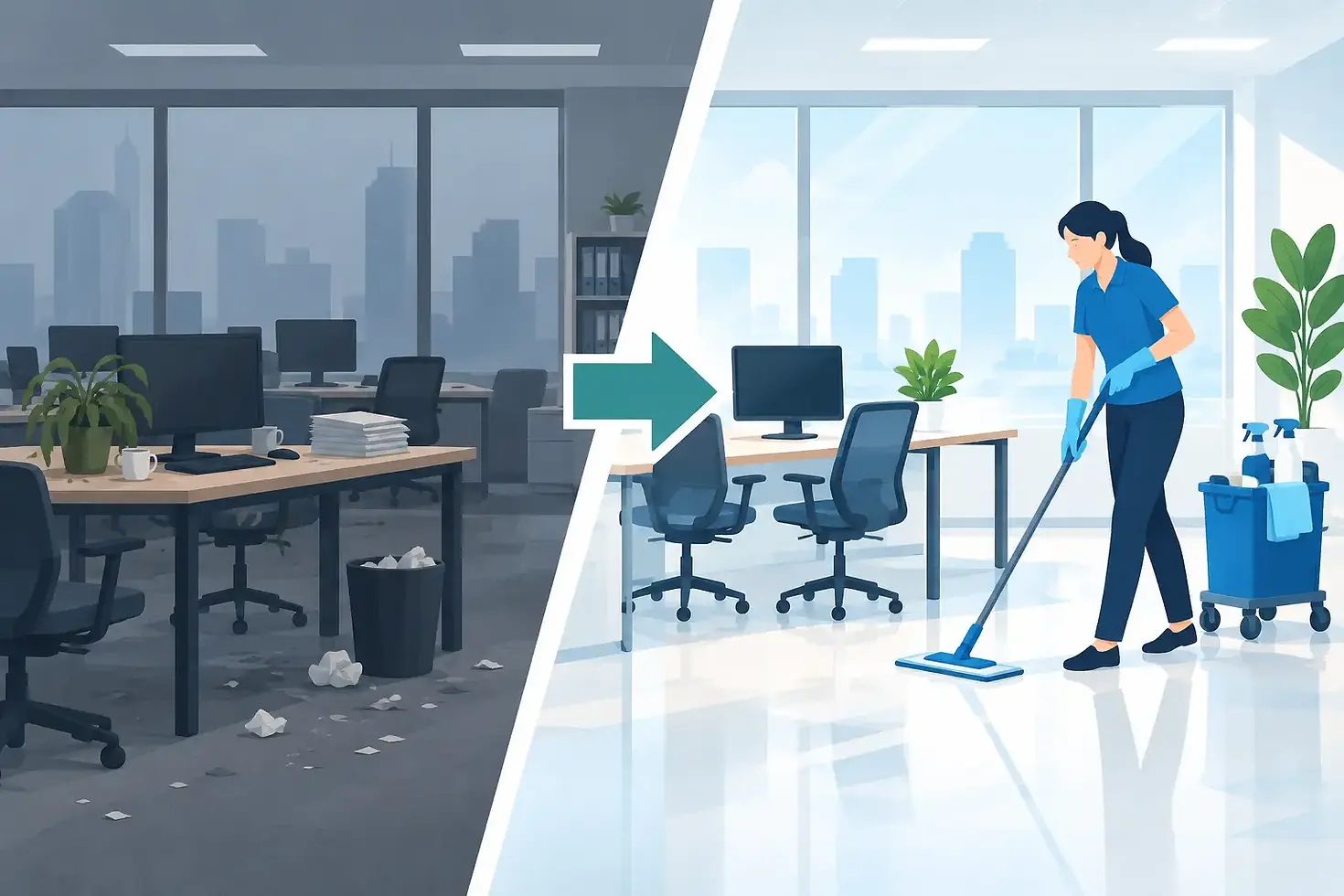
Office Cleaning Transition Example That Works

A bad janitorial changeover rarely starts with a missed trash can. It starts with unanswered questions: Who has keys? Which doors need special access? What happens to the cleaning schedule on Friday night? An effective office cleaning transition example shows how to replace an unreliable provider without creating a new headache for your team.
For Tampa Bay facility managers and office administrators, the goal is not simply to hire a different cleaning company. The goal is to get your sanity back. Your employees, visitors, tenants, and customers should see a clean, ready workplace while the transition happens quietly in the background.
Why Cleaning Transitions Go Wrong
A new cleaning contractor can have capable employees and good intentions, yet still get off to a poor start if the handoff is rushed. A generic scope of work may say “clean restrooms” without identifying high-traffic fixtures, supply expectations, day porter needs, or the preferred time for service. The crew may arrive with the right equipment but no clear directions about alarm procedures, loading access, sensitive areas, or where to dispose of trash.
That uncertainty becomes your problem. Someone from your staff ends up walking the building at night, fielding complaints in the morning, and explaining the same expectations more than once. That is exactly the burden a commercial cleaning provider should remove.
The strongest transitions are planned around the facility, not around a standard sales package. A medical office has different priorities than a warehouse. A bank may require strict access controls. A corporate office may need conference rooms, kitchens, and restrooms reset before employees arrive. The schedule, staffing, equipment, security process, and inspection points should reflect those realities.
Office Cleaning Transition Example: A Controlled 30-Day Start
Consider a mid-sized Tampa Bay office with 75 employees, a public reception area, two conference rooms, a break room, six restrooms, and executive offices. The previous cleaning company was inconsistent. Trash was occasionally missed, restroom supplies ran low, and the office manager had to send frequent emails to correct basic issues.
The new provider does not begin by sending a crew over with a checklist and hoping for the best. The process starts with a walkthrough involving the office manager and the person responsible for the cleaning account. Together, they identify what is not working, what must not be disrupted, and what “clean” means in each area.
Before the First Service
During the walkthrough, the cleaning partner documents the building layout, floor types, square footage, traffic patterns, and service hours. The office manager points out the reception desk, areas where confidential paperwork may be left behind, the executive suite, and the break room refrigerator that needs attention every Friday.
The provider also confirms practical details that are easy to overlook until they cause a problem. These include entry procedures, alarm instructions, key or badge control, parking, elevator access, dumpster location, supply storage, and the contact person for after-hours questions. For a facility with heightened security requirements, background-screened employees and controlled access procedures should be discussed before anyone enters the building.
At this stage, the scope is customized. The agreement may include nightly trash removal, restroom sanitation and supply replenishment, vacuuming, hard-floor care, dusting, break room cleaning, and touchpoint disinfection. It can also establish periodic work such as interior window cleaning, carpet extraction, or stripping and waxing floors. Specificity protects both sides. The customer knows what to expect, and the cleaning team has clear standards to meet.
The Initial Deep Clean
In this example, the first visit is scheduled as a detailed reset rather than a routine nightly clean. The team addresses accumulated dust on ledges, stains in carpet, buildup around restroom fixtures, fingerprints on glass, and neglected corners behind furniture. This first service gives the facility a clean baseline.
A deep clean does take more time than normal maintenance cleaning, and it may need to be scheduled separately from the ongoing contract. That is usually worthwhile when a previous provider has fallen behind. Starting with an honest assessment is better than promising a perfect result overnight with no allowance for the condition of the building.
The office manager receives a clear explanation of what the initial service includes and what may require separate specialty work. For example, old carpet stains may improve with extraction but not disappear if they have permanently damaged the fibers. Worn floor finish may need stripping and waxing, not just mopping. Direct communication prevents surprises and makes the plan credible.
The First Two Weeks of Service
Once routine cleaning begins, consistency matters more than grand promises. The assigned team follows the approved scope and cleaning schedule, while a site manager performs inspections to verify the work. The inspection is not just a paper exercise. It should focus on the places employees and visitors notice first: entry glass, restrooms, floors, trash receptacles, break rooms, and conference spaces.
The office manager should have one point of contact for questions or concerns. If a restroom dispenser is empty or a meeting room was missed, the response should be quick and straightforward. No one should have to hunt down individual cleaners or wonder whether an email disappeared into a corporate inbox.
During this period, small adjustments are normal. Perhaps the break room needs an extra service after busy lunch days. Maybe the lobby requires more attention during rainy weather, or a conference room should be cleaned earlier before a standing morning meeting. A responsive contractor treats those details as part of managing the account, not as an inconvenience.
The 30-Day Review
After the first month, the provider and office manager review what is working and what needs adjustment. They compare the original scope with the reality of the building. Are consumables lasting? Is the cleaning schedule right for the traffic level? Have employee complaints stopped? Are there areas that need periodic attention rather than nightly service?
This is also the right time to plan specialty services. A property may benefit from quarterly carpet cleaning in high-traffic hallways, monthly floor maintenance, or a scheduled ceiling-to-floor detail before an audit, client event, or seasonal rush. The best plan is not necessarily the most expensive one. It is the plan that keeps the facility ready without paying for work that does not match the building’s needs.
What Your Transition Plan Should Cover
A professional transition plan should be easy to understand and specific enough to hold the cleaning company accountable. Before the first shift, confirm these essentials:
A written, customized scope that identifies daily, weekly, and periodic services.
Building access, key control, alarm, parking, and security procedures.
Named account contacts for routine questions and urgent after-hours concerns.
Employee screening, training, and expectations for professional conduct on-site.
A quality-control process that includes inspections and a clear method for correcting issues.
If a provider cannot explain these points in plain language, it may be a sign that the transition will require too much of your supervision. A low price can become expensive when your management team spends time tracking missed work, replacing supplies, or responding to employee complaints.
Protecting Your Facility During the Change
There is a practical reason to avoid changing cleaning providers without notice or preparation. The outgoing company may still have keys, codes, or access credentials. The incoming crew may not yet understand where sensitive materials are kept or which spaces should remain locked. Access should be reviewed carefully, and credentials should be collected, changed, or reassigned according to your company’s procedures.
It is also smart to tell internal staff what will change, especially if service times, trash collection points, or supply locations will be different. You do not need to make a major announcement. A brief message can prevent confusion and encourage employees to report concerns through the right channel instead of letting frustration build.
For facilities that operate around the clock, the transition may need to happen in phases. A manufacturing site, healthcare setting, warehouse, or airport-related facility cannot always pause operations for a major reset. In those cases, the cleaning plan must account for production schedules, safety rules, restricted zones, and ongoing foot traffic. The right approach depends on the facility, but accountability should never be optional.
Choose a Partner Who Owns the Result
The difference between a vendor and a dependable janitorial partner is what happens after the contract is signed. A vendor may simply send a crew. A partner stays involved, inspects the work, answers the phone, and resolves the issue before it becomes a pattern.
Florida Cleaning Contractors builds transitions around local management, trained and background-screened employees, customized programs, and regular site oversight. Whether your building needs nightly office cleaning, specialty floor care, carpet cleaning, trash removal, or a full facility reset, the service should fit your operation instead of forcing your operation to fit a generic checklist.
If your current cleaning company has made cleanliness another task on your desk, do not wait for the next client visit or employee complaint to make a change. Start with a walkthrough, ask direct questions, and expect a transition plan that lets you walk into a clean facility without wondering what happened the night before.


